

Published on October 9, 2025 by Ethan Hartley
By the early spring of 2027, if all goes to plan, a formerly blighted stretch of one of East Providence’s most central, downtown corridors will open its doors as an example of the possibilities that exist when creative minds and altruistic organizations work together to combat the state’s significant affordable housing problem.
But the road to get to this point, and indeed the road left to be traveled, also underscores a troubling reality facing nonprofit developers; who make it their mission to build truly affordable housing at a rate that will make an actual difference in the lives of the thousands of people who need it, and without steamrolling residents in the process.
From vacant to a vision
For over a decade, the building at 350 Taunton Ave. in East Providence sat unoccupied and rotting in the elements. Built in 1975, it was formerly a dormitory for Johnson & Wales University, and then became a retirement community. Two vacant lots on either side of it, 330 and 354 Taunton Ave., added up to a whole bunch of unfulfilled potential for the city and its residents.
In 2022, that changed when Foster Forward, a nonprofit located about a mile west off Taunton Avenue, reached out to Providence-based nonprofit housing developer, One Neighborhood Builders, and informed them that the privately-held properties were on the market.
Using a combination of their own reserves, an acquisition loan from Local Initiatives Support Corporation (LISC) RI, a grant from the Rhode Island Foundation, and a $1 million grant from Rhode Island Housing’s site acquisition program, One Neighborhood Builders were able to purchase all three parcels for $4.5 million in March of 2023.
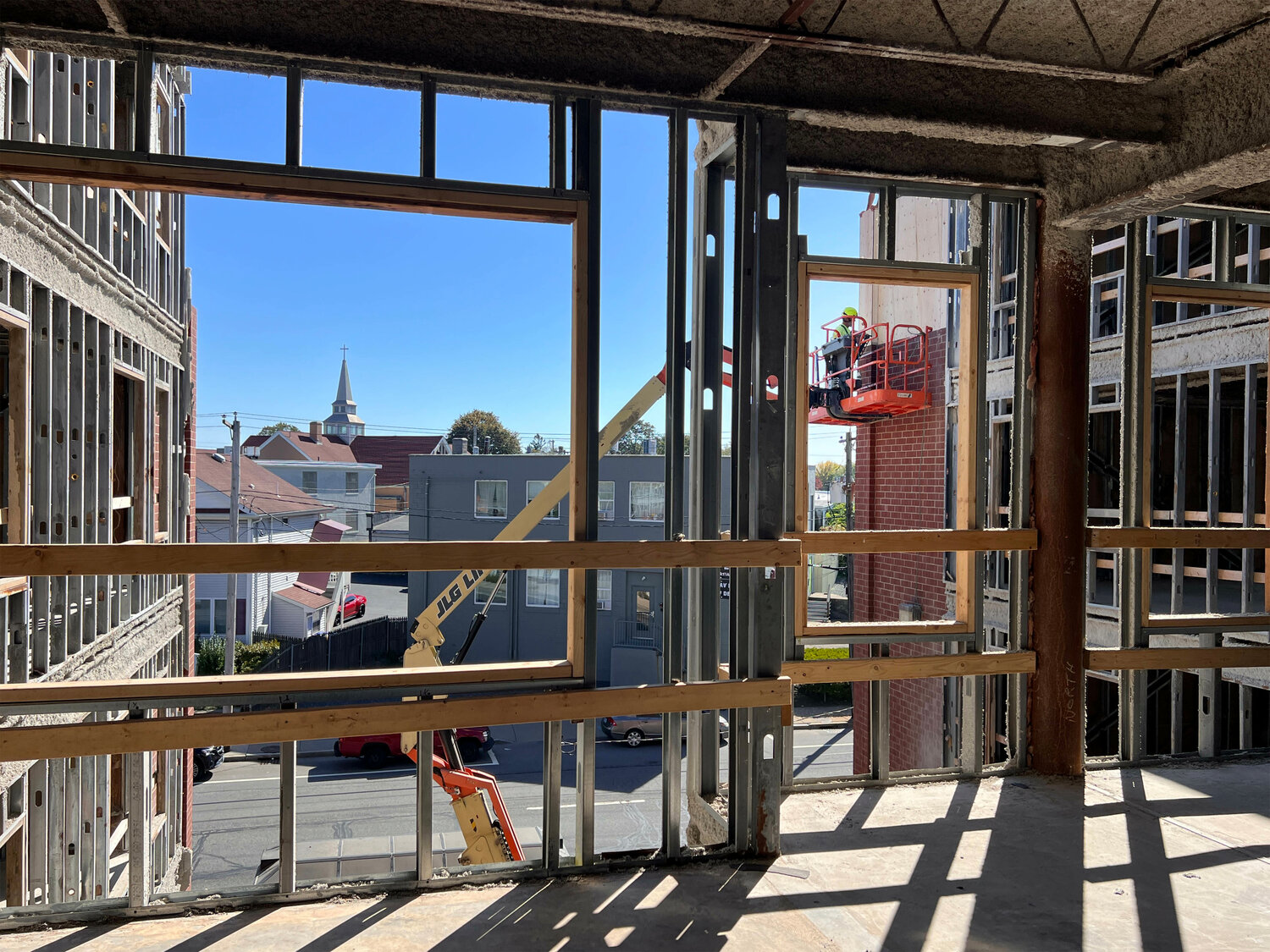
The project, dubbed “Center City Apartments”, is to be carried out in two phases. During a site visit on Monday, general contractor Pezzuco Construction Inc., of Cranston, could be seen in the early stages of rehabbing the existing structure at 350 Taunton Ave. and beginning foundation work on the construction of a new, four-story building to be built on the 330 Taunton Ave. parcel. A mirror-image of that building will be built during the second phase at 354 Taunton Ave.
In total, the development will create 144 units of housing (a mix of studios, one-, two-, and three-bedrooms). Of those, 60% will be opened up to people making up to 80% of the area median income, and the remaining 40% will be set aside entirely for “permanent supportive housing”, set aside for people most at risk of becoming homeless (individuals and families earning a maximum of 30% of the area median income). All of the units will be deed-restricted in this configuration for the next 99 years.
[…]Making it happen takes a village
As opposed to some affordable housing projects making headlines in other communities throughout Rhode Island, One Neighborhood Builders found enthusiastic partners among the administration in East Providence.
“One of the main reasons why we were so successful is our amazing partnership with the City of East Providence,” Bleau said. “The mayor was really supportive, as well as folks in the planning department and other municipal departments. They were truly our partners in this entire endeavor.”
However, they did still experience one of the most common traps that affordable housing projects fall into — parking concerns.
They had originally sought to build 160 total units, and proposed a ratio of 0.75 parking spaces per unit to accommodate that (state law dictates a 1:1 ratio). While all other density-related zoning requirements were met, they did request a variance for the parking burden to be reduced — making the case that especially low-income Rhode Islanders likely wouldn’t have multiple cars, and in many cases would have no car at all.
“We would never build something that ultimately would would suffer in that operational way,” Bleau said. “Unfortunately, and as was within their right, the zoning board was not comfortable granting that.”
As a result, One Neighborhood scaled the project back to 144 units, which will include 145 parking spaces.
“The result is we lost affordable units,” Bleau lamented.
Additionally, they had a vision to make the property a mixed-use development with an early learning center (or some variation of a daycare facility) embedded in the building. But such a use would also require more parking.
“We just couldn’t meet the requirements,” she said.
But more than any zoning or parking issue, by far the biggest challenge for One Neighborhood Builders, and nonprofit developers like them, is gathering the necessary funding.
“Our final capital stack, including pre-development as well as permanent sources of financing, is over 22 sources,” Bleau said. “That’s for pre-development, acquisition, construction.”
Those sources include the aforementioned grants and loans required to acquire the property, along with a low-interest, $3 million loan from the Rhode Island Foundation, which was just announced on Oct. 1, to help them fully finance the first phase of the construction. They will still need to secure competitive funding from Rhode Island Housing, along with other sources, to finance the second phase in the coming months and years.
“As much as we would like to say this is not characteristic of the typical affordable housing deal, what you’re seeing in the region, what you’re seeing across the country, is that it has become more complex to build affordable housing,” said Peter Chapman, President and CEO of One Neighborhood Builders. “And it means organizations like ours need to be much more creative to put these deals together.”
Chapman, who became the nonprofit’s new president in February of 2025, comes from a long career in Massachusetts, where he said he sees tactics that he believes Rhode Island should be replicating.
“I think that there’s a lot more that could and should be done in order to incentivize development, both for for-profit and nonprofits,” he said. “Massachusetts has been looking at this for 40-50 years and, through something called Chapter 40 or Chapter 40B, has implemented a lot of reforms and a lot of supportive elements to help incentivize affordable housing development, in particular affordable housing development that’s undertaken by nonprofit entities like community development corporations.”
He said that more recent actions have included the establishment of a new tax credit to specifically support nonprofit developers separate from the project-specific federal tax credits so sternly fought over in places like Rhode Island.
“This is a tax credit program that’s intended to benefit the operations of nonprofit developers so that they have the capacity over the long term to take on complex projects, like affordable housing projects, mixed income projects, even some mixed-use projects,” Chapman said. “Massachusetts has, I think, distinguished itself as a case study that’s worthy of exploration by folks here in Rhode Island.”


